

As a solopreneur or small business trying to grow sales, it can feel like the game is rigged. You might be losing deals to a competitor with a full sales team, lamenting your lack of ad budget or struggling to scale marketing without an enterprise-grade automation platform. But in reality, you probably just need to overhaul your suite of sales tools.
Today's buyers expect professional, seamless experiences regardless of company size. The seller who earns the deal isn't always the one with the most experience. The winner is often the one who shows up prepared, follows up consistently and communicates value clearly. You don't need to spend hundreds of dollars a month to deliver that kind of experience: you need a strategic tool selection backed by a proven sales methodology.
This guide focuses specifically on free and low-cost options built for solopreneurs and small business owners competing in B2B sales. More importantly, it shows how pairing these tools with a proven sales approach, like Stop Selling > Start Solving® helps you maximize every dollar and every hour invested.
If you’re wondering What is a solopreneur sales toolkit? Our definition is simple:
It’s a curated collection of affordable, easy-to-implement resources that enables individual sellers to execute professional-grade prospecting, relationship management and deal tracking without enterprise-level budgets or technical expertise.
Read More: Eager to Quiz Your Existing Solopreneur Skills? Start Here
Why Solopreneurs Need a Different Approach to Sales Tools
Tools help you implement and achieve, but they don't sell for you. Stop Selling > Start Solving is what makes your tools effective. Without a proven sales methodology behind them, even free tools become expensive and waste your time.
Solopreneurs need three things from their tech stack: simplicity, affordability and immediate ROI. We know your constraints are both budget and time. You can't spend weeks learning complex software or troubleshooting integrations.
The right tools amplify your methodology and handle the administrative load so you can focus on the strategic work only you can do: building relationships, qualifying opportunities and articulating value. Once you understand the model, the right tools will help you implement it.
The 7 Essential Free & Low-Cost Tools Every Solopreneur Needs
Finding the best resources can feel overwhelming, but the right tools make a real difference. The applications below all have a free tier or cost less than $100 per month, and each is accessible for any solopreneur serious about building a professional sales system.
1. Customer Relationship Management
A CRM tool is non-negotiable, as it helps sales professionals manage customer data in one place, track conversations and surface patterns that would otherwise get lost in a crowded inbox. Here are our top picks:
- HubSpot CRM: Free tier & best for getting started with contact management
- Streak: Gmail-based & best for consultants who rely heavily on their inbox
- Pipedrive: Affordable & best for visual pipeline management
Even with just 20 prospects, a CRM prevents dropped balls and surfaces the patterns that inform your next move. ValueSelling Framework®'s emphasis on understanding buyer personas and tracking value metrics works well alongside CRMs, as these metrics require accurate, organized data.
2. Email Sequencing & Outreach
Inconsistent follow-up can leak revenue. Luckily, email sequencing tools automate your cadence without making every message feel robotic, so no prospect falls through the cracks. Here are our suggestions:
- Apollo.io: Best for combined enrichment and outbound
- Lemlist: Best for personalization at scale
- HubSpot Sequences: Best for those already in HubSpot
The Stop Selling > Start Solving's approach to prospecting emphasizes multi-threading, which means staying connected to multiple stakeholders across the buyer journey. Sequencing tools make that structurally possible. Vortex Prospecting® recommends a cadence of 15-17 touches across 20-25 business days, mixing outreach types and never going more than five business days between contacts. That discipline, automated intelligently, is what separates consistent solopreneurs from forgettable ones.
Read More: Explore Our Guide to Sales Prospecting Techniques
3. Social Selling & Prospecting Intelligence
Social selling is about connecting with customers and growing relationships through the channels where they already spend time. Yet, you can't build relationships without first finding the right people, which makes prospecting the strategic foundation on which everything else depends. Our top picks are:
- LinkedIn Sales Navigator: Freemium & best for B2B prospecting and research
- Dripify: Affordable & best for LinkedIn automation
- Hunter.io: Best for finding verified email addresses
These tools give you the intelligence to do that at scale, so your first outreach is relevant and intentional. Start building customers for life during that first conversation.
4. Scheduling & Meeting Coordination
Every sales professional knows that friction kills momentum, but that friction can be as simple as back-and-forth emailing to schedule a meeting. Scheduling tools eliminate the coordination overhead and ensure a smooth relationship from the jump. Our best scheduling picks include:
- Calendly: Free/paid tiers & best for eliminating email back-and-forth
- Cal.com: Open-source & best for customization without the cost
When prospects can book time with you in one click, you remove a barrier and create a better first impression at the same time.
5. Video Messaging & Demos
Video has moved from a nice-to-have to an expectation in today’s world. It pre-qualifies interest and creates a human connection that text can't replicate. Today, 29.2% more B2B websites now use a "Take a Tour" call to action than just two years ago, and interactive demos on top B2B SaaS sites have grown 80% since 2022.
Our best video messaging and demo options are:
- Loom: Free tier & best for async video messages
- Vidyard: Best for video tracking and analytics
- Zoom: Best for live demos and recorded calls
These tools build relationships at scale and directly support Growist's competitive differentiation principles, showing prospects both what you do and why it matters to them.
6. Proposal & Contract Management
Sales is about more than identifying the right prospects: it’s also about maintaining strong relationships, and that involves clean and professional documentation. A polished proposal signals that working with you will be organized, professional, and collaborative. Our suggested proposal and contract management platforms are:
- PandaDoc: Best for professional proposals with e-signature
- Proposify: Best for template-based proposals
- DocuSign: Best for when you just need signatures fast
Professional documentation builds credibility and eliminates any buyer doubt. Make sure your proposal clearly articulates the buyer's business case and quantified value.
7. Analytics & Performance Tracking
Solopreneurs who track their performance metrics — not just revenue, but activity rates, conversion rates and pipeline velocity — make smarter decisions faster. McKinsey & Company research consistently shows that data-driven sales teams outperform those that operate on instinct alone. Our top picks for sales analytics and performance tracking are:
- Google Sheets / Airtable: Free & best for DIY dashboards
- Databox: Best for connecting multiple data sources
- CRM native analytics: Best for if your CRM already offers solid reporting
If you can't measure what's working, you can't scale it. That’s why Stop Selling > Start Solving® emphasizes quantifying value — you just need the right tools to do so.
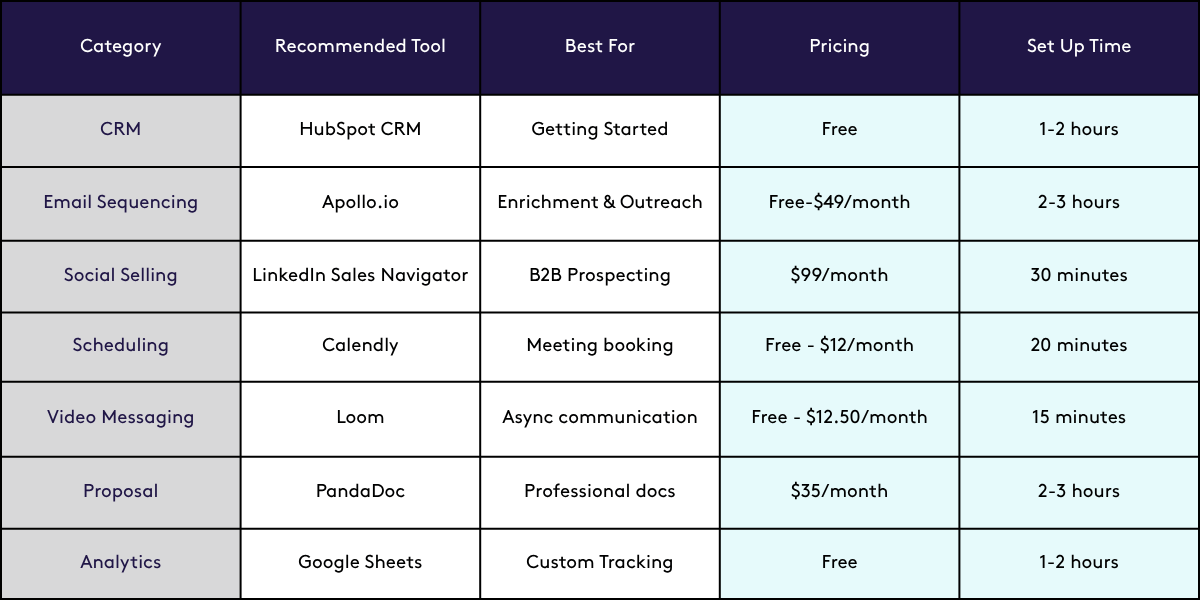
Solopreneur Sales Toolkit: Quick Comparison
There are hundreds of platforms available to help your solopreneur career or small business succeed. While building your sales toolkit will come down to budget, business goals and time constraints, here are our seven suggested resources that give you options to level up your sales processes no matter what your business looks like.
How the Stop Selling > Start Solving Maximizes Your Tool Investment
Tools without a methodology are just overhead. The Stop Selling > Start Solving provides the strategic foundation that makes every tool in your stack exponentially more effective. Here's what happens when you blend proven methodology with the right technology:
Qualification gets smarter. Your CRM becomes powerful when you know exactly which prospects to prioritize. Growist's qualify-to-close formula helps you identify high-probability opportunities, so you invest your time where it actually pays off. Eliminate no-decision outcomes through continuous qualification built into your process.
Outreach gets strategic. Email sequences and social selling tools work better when you lead with differentiated value, not generic pitches. Growist trains you to lead with business pain and quantified value first, differentiating you from competitors.
Proposals convert. A proposal tool is only as good as what you’re offering. Growist's mutual business case approach means your proposals are both professional and speak directly to the buyer's ROI.
Relationships deepen. Video and communication tools are most effective when you understand stakeholder mapping, buyer behavior and multi-threading across the buyer journey. Strong communication drives results, and that starts with understanding how buyers actually make decisions.
If you are ready to close business this quarter, start your strategy with the right foundation. Built on the foundation of the proven ValueSelling Framework sales methodology, Growist has the resources you need as a solopreneur or small business owner to excel.
Build Your Competitive Advantage Starting Today
The most successful solopreneurs don't win by outspending the competition. They win because they combine smart technology with a proven sales framework.
Your toolkit handles the administrative heavy lifting, while your sales training program enhances your selling skills to ensure every prospect interaction is strategic and value-focused.
Remember: you don’t have to compete with big, enterprise teams. Start with the free tiers, upgrade strategically as revenue grows and never mistake tool complexity for sales capability.
Ready to combine your new sales toolkit with a proven methodology? Discover how Growist brings the Stop Selling > Start Solving to individual sellers and solopreneurs without enterprise price tags or complexity.
Read More: Let’s Start the Conversation
Read More: Sign Me Up for the Growist Community
Your Solopreneur Sales Tools Questions Answered
What sales tools do I actually need as a solopreneur?
Start with three essentials: a CRM, a scheduling tool and video conferencing. These cover contact management, meeting coordination and professional communication. Then, you can add tools strategically as your business and revenue grow.
How much should I budget for sales tools as a solopreneur?
Start at $0 using free tiers, then budget $50-150 per month as you scale. That gets you professional-grade capabilities across all seven categories, compared to enterprise teams spending thousands per user monthly. Reinvest the difference in sales training built for solopreneurs, like the Stop Selling > Start Solving.
How much time should I spend on sales tools vs. actual selling?
It’s best to follow the 80/20 rule: 20% of your time setting up and optimizing tools, 80% using them to sell. If you're spending more time managing software than talking to prospects, you're over-complicating your stack.
Do I need a CRM if I only have 20 prospects?
Absolutely. Even with 20 prospects, a CRM prevents missed follow-ups, tracks conversation history and documents each buyer's specific value drivers. More importantly, you build the habits early that become your edge at 200 prospects.
What's the difference between solopreneur tools and enterprise sales tools?
Enterprise tools prioritize tools you probably don’t need, like team collaboration, manager dashboards, complex workflows and extensive customization. Solopreneur-friendly tools focus on individual productivity, quick setup, intuitive interfaces and accessible pricing. Choose tools that match your current reality, not a theoretical future.
More Resources
Find valuable resources for your needs


Start Growing Revenue Today
